

Disclaimer: I am a blogger and an investor, not a SEBI-registered investment adviser. What I share here comes from my own learning since 2021. Please treat it as information, not personal financial advice.
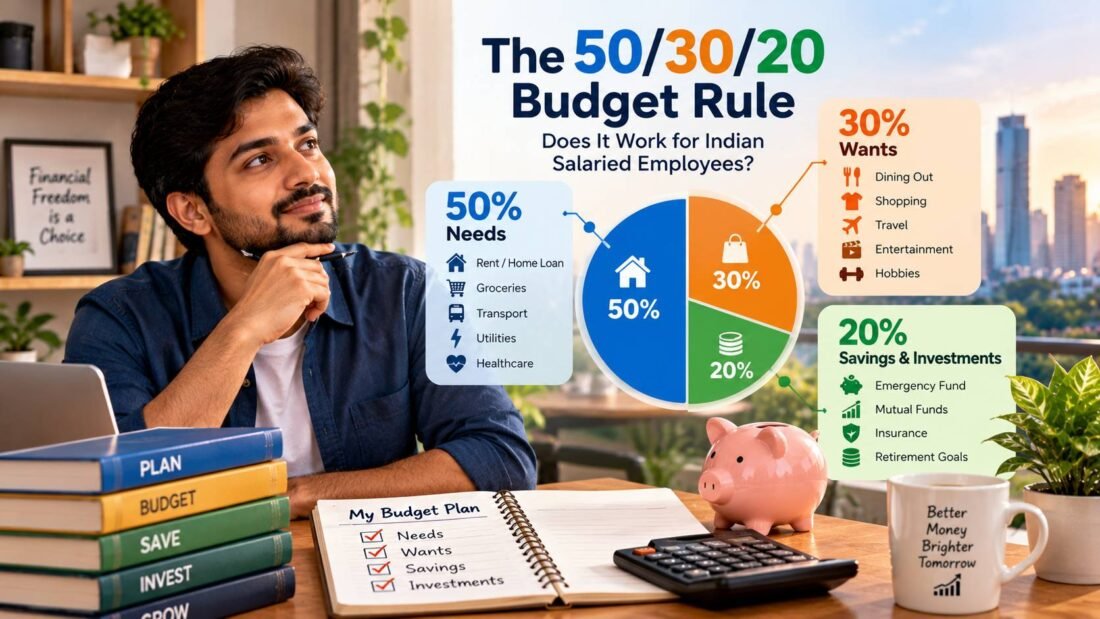
The 50/30/20 rule is probably the most shared budgeting tip on the internet. Half your income for needs, 30% for wants, 20% for savings. Simple, neat and easy to remember.
But it was made for American households. So does it work when you earn in rupees, pay Mumbai or Bengaluru rent, support your parents and have three family weddings every winter?
Quick answer: The 50/30/20 budget rule works well as a starting point for Indian salaried employees, but most people need to adjust it. Lower incomes and metro renters often do better with 60/20/20 or 70/10/20, while higher earners can save more with 50/20/30. The part worth protecting is the savings share.
What the 50/30/20 Rule Actually Says
The rule was popularised by Elizabeth Warren and Amelia Warren Tyagi in their 2005 book All Your Worth. It splits your after-tax income into three parts:
- 50% Needs: rent or home loan EMI, groceries, utilities, insurance, basic transport, school fees, minimum loan payments
- 30% Wants: eating out, travel, shopping, entertainment, gadgets, subscriptions
- 20% Savings and debt repayment: emergency fund, SIPs, PPF, extra loan prepayment
For Indians, “after-tax income” simply means your in-hand salary, the amount that actually hits your bank account. If you are not sure what counts as a need, our post on needs vs wants breaks it down.
Testing the Rule on Real Indian Salaries
According to MoSPI’s Periodic Labour Force Survey Annual Report 2025, released in March 2026, the average regular salaried worker in India earned ₹21,285 a month in 2025. Men averaged ₹24,217 and women ₹18,353.
Let’s apply the rule to three salary levels:
| In-hand Salary | Needs (50%) | Wants (30%) | Savings (20%) |
|---|---|---|---|
| ₹21,285 (national average) | ₹10,640 | ₹6,390 | ₹4,255 |
| ₹50,000 | ₹25,000 | ₹15,000 | ₹10,000 |
| ₹1,00,000 | ₹50,000 | ₹30,000 | ₹20,000 |
At the national average salary, ₹10,640 for all needs is very tight in any city. The HCES 2023-24 survey found that average urban spending is ₹6,996 per person per month. For a family of even two or three, needs alone cross the 50% line easily.
At ₹50,000, the rule starts to look possible in a tier-2 city. In a metro with ₹20,000 rent, it gets difficult again.
At ₹1,00,000, the 30% wants bucket is ₹30,000 a month. Many people at this level could save far more than 20%.
Where the Rule Fits Indian Life (and Where It Doesn’t)
- EPF is already saving for you. Your EPF contribution is cut before salary reaches your account. So if you follow 50/30/20 on in-hand pay, your real savings rate is actually higher than 20%. That is a quiet advantage for salaried Indians. Our comparison of EPF, PPF and NPS explains each one.
- Family support is a need. Money sent to parents is not a luxury in most Indian homes. Put it under needs, even if that pushes needs past 50%.
- Festivals and weddings are tricky. Diwali shopping is partly a want, but gifts at a cousin’s wedding are a social obligation. Plan these through a monthly yearly-expenses fund, as shown in our monthly budget guide, so they do not break the split in one month.
- Metro rent breaks the 50%. In big cities, rent alone can take 30% to 40% of a young professional’s salary. That leaves very little for the rest of the needs.
- Joint families can make it easier. When rent and groceries are shared, needs may fall well below 50%, leaving room to save more.
- EMIs need sorting. A home loan EMI is a need. An EMI on a phone or a holiday is really a want paid later. Extra prepayment on a loan counts in the 20%.
How Much Do Indians Actually Save?
RBI’s Annual Report (May 2026) shows household net financial savings at 7.0% of gross national disposable income in 2024-25, up from 5.8% in 2023-24. Gross financial savings were 11.8%, and savings in physical assets like property were another 13.6%.
These national figures are measured differently from a personal budget, so they are not a direct comparison. But they make one thing clear. Saving 20% of your take-home pay in financial products puts you well ahead of the average Indian household. The target is ambitious, and that is fine.
Versions of the Rule That Work Better in India
| Split (Needs/Wants/Savings) | Best For |
|---|---|
| 70/10/20 | Early career, low salary or tight months, but savings still protected |
| 60/20/20 | Metro renters and single-income families with dependents |
| 50/30/20 | Mid-level salaries in tier-2 cities with manageable rent |
| 50/20/30 | Higher earners or anyone with a big goal like a home down payment |
Notice that savings stays at 20% or more in every version. If something has to give, it should be wants first.
How I Think About the Savings 20%
I started investing in 2021, mainly through SIPs, along with stocks, FDs and bonds. One lesson I learned the hard way: I stopped a portion of my SIPs early once. At that time it felt like a sensible way to free up cash. Looking back, it broke the rhythm I had built.
So now I treat the savings share as the first bill of the month, not the last. It moves out on salary day, automatically.
Part of that savings also becomes buffer money I keep for falling markets. That is a personal habit, and it only works because the savings bucket is filled before anything else.
How to Try the Rule for Three Months
- Month 1: Track every expense and label it as need, want or savings. Do not change anything yet. Just see your real split.
- Month 2: Pick the version from the table above that is closest to your reality. Automate the savings share on salary day.
- Month 3: Review. If needs keep crossing the limit, check rent, EMIs and subscriptions. If wants keep crossing, use a separate wants account.
Recheck the split once a year. With retail inflation at 5.54% in September 2026 and food inflation at 7.74%, your needs bucket will keep growing unless your salary grows faster.
Conclusion
The 50/30/20 budget rule is a good starting point, not a strict law. For many Indian salaried employees, especially those on average incomes or paying metro rent, a 60/20/20 or 70/10/20 split is more honest.
The numbers in the first two buckets can bend. The savings share should not. Protect that 20%, automate it on salary day, and adjust the rest to fit your life.
Frequently Asked Questions
What is the 50/30/20 budget rule?
The 50/30/20 rule divides your take-home income into three parts: 50% for needs like rent and groceries, 30% for wants like eating out and shopping, and 20% for savings, investments and extra debt repayment.
Does the 50/30/20 rule work in India?
It works as a starting framework, but many Indians need to adjust it. High metro rent, family support and lower average salaries often push needs above 50%. Versions like 60/20/20 or 70/10/20 tend to suit those situations better while still protecting savings.
Should I use CTC or in-hand salary for the 50/30/20 rule?
Use in-hand salary. The rule is meant for after-tax income, which in India means the amount credited to your bank account after TDS, EPF and other deductions.
Does EPF count in the 20% savings?
EPF is already deducted before your in-hand salary, so it is not part of the 20% when you apply the rule to take-home pay. This means your total savings rate is actually higher than 20% if you follow the rule.
Where do EMIs fit in the 50/30/20 rule?
Home loan EMIs and essential loans usually fit under needs. EMIs for gadgets, holidays or lifestyle purchases are better counted as wants. Any extra prepayment you make on a loan can be counted in the savings and debt repayment share.
What is a better budget rule for low salaries in India?
For low or entry-level salaries, a 70/10/20 split is often more realistic. It allows more room for essential costs, keeps wants small and still protects a 20% savings habit. If 20% is not possible, start with 10% and raise it over time. Our guide on saving on a ₹25,000 salary has a worked example.
How much should a salaried person save every month in India?
Saving 20% of in-hand salary is a strong target. Beginners can start with 10% and increase it with each increment. Higher earners with low fixed costs can aim for 30% or more, especially if they have a big goal like a home or early retirement.