

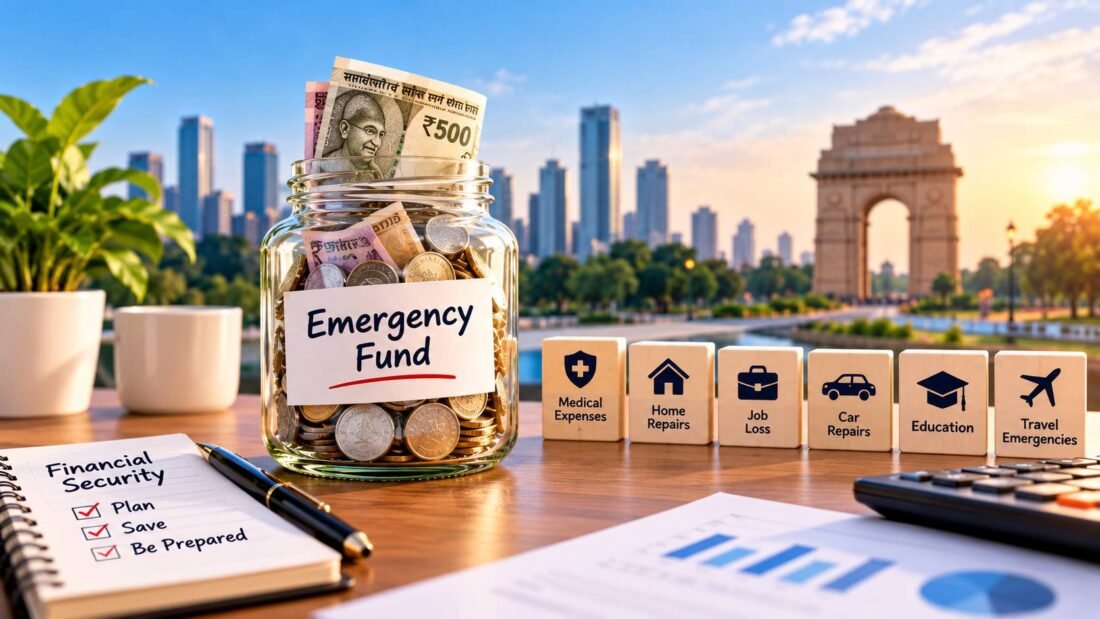
Disclaimer: I am a blogger and an investor, not a SEBI-registered investment adviser. What I share here comes from my own learning since 2021. Please treat it as information, not personal financial advice.
Most financial emergencies in India do not announce themselves. A parent gets admitted to hospital. A company announces layoffs. The car needs a repair you did not plan for.
Health costs alone are a big reason to be ready. The National Health Accounts estimates for 2022-23 show that Indian households paid 43.4% of the country’s total health expenditure from their own pockets, up from 39.4% a year earlier.
Quick answer: An emergency fund in India should usually cover 6 months of essential expenses. Keep 3 to 4 months if your household has two stable incomes, and 9 to 12 months if you are self-employed or the only earner. Keep it in a savings account, fixed deposits or a liquid fund, never in stocks.
What Counts as an Emergency (and What Does Not)
An emergency fund only works if you are strict about when you use it.
Real emergencies:
- Job loss or a sudden pay cut
- Medical treatment not fully covered by insurance
- Urgent home or vehicle repair you need for daily life
- A family emergency that needs travel or money quickly
Not emergencies:
- A festival sale or a new phone launch
- A vacation, even a cheap one
- A wedding you knew about six months ago
- A “great opportunity” in the stock market
Planned costs belong in a separate yearly expenses fund. Our monthly budget guide shows how to set that up.
How to Calculate Your Ideal Emergency Fund
The formula is simple:
Emergency fund = Essential monthly expenses × Number of months
Step 1: Find your essential monthly expenses
Count only what you must pay even in a bad month:
- Rent or home loan EMI
- Other EMIs
- Groceries and household basics
- Electricity, gas, phone and internet
- Insurance premiums (monthly share)
- School fees (monthly share)
- Basic transport
- Money you send to parents or dependents
Leave out eating out, shopping, OTT and travel. In a real emergency, those get cut first.
Step 2: Choose the number of months
| Your Situation | Months to Keep |
|---|---|
| Two earners, both with stable salaried jobs | 3 to 4 months |
| Single earner with a private salaried job | 6 months |
| Single earner with kids or dependent parents | 6 to 9 months |
| Self-employed, freelancer, business owner or commission income | 9 to 12 months |
Step 3: Multiply
Say your essential expenses are ₹32,000 a month and you are a single earner in a private job.
₹32,000 × 6 = ₹1,92,000
That is your target. Not a random round number, but one based on your actual life.
Step 4: Adjust for insurance
If you have no health insurance, add more months, because one hospital bill can wipe out a fund. If you have good family floater cover, your fund mainly needs to handle deductibles, non-covered items and the time before a claim is settled.
Where to Keep Your Emergency Fund
An emergency fund has one job: be available quickly without losing value. Returns come third.
| Option | Access | Good For | Watch Out For |
|---|---|---|---|
| Savings account | Instant | First 1 month of expenses | Low interest |
| Fixed deposit (with sweep-in or broken into smaller FDs) | Same day in most banks | Main part of the fund | Penalty on premature withdrawal at many banks |
| Liquid mutual fund | Usually next working day | Part of the fund for those comfortable with mutual funds | Returns are not guaranteed; a small exit load applies if you redeem within the first 7 days |
A simple split that many people use: one month of expenses in your savings account, and the rest in FDs or a liquid fund. You can read more about liquid funds on AMFI’s investor education pages.
FDs are part of my own investments, and for this purpose I like one thing about them. The amount does not move with the market. When you need money in a hurry, the last thing you want is to find it down 15%.
Why not stocks or equity mutual funds? Markets often fall at the same time jobs are at risk, like in early 2020. You do not want to sell investments at a loss just to pay rent. Our post on risk and return explains why.
Emergency Fund vs Buffer Money for Investing
This is a distinction I care about. One habit that has worked for me as an investor is keeping some buffer money on hand for falling markets, so I can invest when prices are down.
That buffer is not an emergency fund. In my view they should be two separate pots.
If you use your emergency money to “buy the dip” and then lose your job the next month, you are stuck. Build the emergency fund first. Market buffer money comes after.
How to Build Your Emergency Fund Step by Step
1. Start with a small first target. One month of expenses feels possible. Six months can feel like a mountain. Reach the first milestone and the rest feels easier.
2. Automate it. Set a standing instruction or an RD that moves a fixed amount right after your salary is credited.
3. Add windfalls. Put part of your bonus, tax refund or Diwali gift money directly into the fund.
4. Increase it with every hike. When your salary rises, raise the monthly amount before your lifestyle catches up.
Here is a realistic timeline using the earlier example:
| Plan | Time to Reach ₹1,92,000 |
|---|---|
| ₹8,000 a month only | 24 months |
| ₹8,000 a month + ₹30,000 bonus added once | About 20 months |
| ₹12,000 a month | 16 months |
FD or liquid fund interest will shorten these timelines slightly.
Keep Your Fund Updated for Inflation
Your target is not fixed forever. Retail inflation in India was 5.54% in September 2026, with food inflation at 7.74%.
If your essential expenses of ₹32,000 rise by around 5.5% in a year, they become about ₹33,800. Your six-month target then moves to roughly ₹2,02,800.
Review the number once a year, and also after big life changes like marriage, a child, a new EMI or moving cities.
Common Emergency Fund Mistakes
- Using a credit card as the emergency fund. Card interest is often more than 3% a month if you do not pay the full bill. That turns one emergency into two.
- Keeping it all as cash at home. A little cash is fine for immediate needs. Large amounts at home earn nothing and are not safe.
- Investing it in stocks. Equity is for long-term goals, not for money you may need next week.
- Dipping into it for wants. Once you start, it stops being an emergency fund.
- Not refilling it. After you use it, rebuild it before you restart other goals.
Conclusion
An emergency fund is not exciting. It does not grow fast and nobody brags about it. But it is the reason a medical bill or a job loss stays a bad month instead of becoming a loan you carry for years.
Calculate your essential expenses, pick the right number of months, keep the money somewhere safe and easy to reach, and build it step by step. Once it is in place, you can invest with a much calmer mind.
Frequently Asked Questions
How much emergency fund should I have in India?
Most people should keep around 6 months of essential expenses. Households with two stable salaries can manage with 3 to 4 months, while self-employed people and single earners with dependents may need 9 to 12 months.
Where should I keep my emergency fund in India?
Keep about one month of expenses in a savings account for instant access, and the rest in fixed deposits or a liquid mutual fund. Avoid stocks and equity funds because their value can fall just when you need the money.
Is a liquid fund safe for an emergency fund?
Liquid funds invest in very short-term debt and usually have low volatility, with redemption money normally credited the next working day. However, returns are not guaranteed, and a small exit load applies if you redeem within the first seven days. See our guide to exit loads.
Should I build an emergency fund or invest first?
Build at least a basic emergency fund first, even one to three months of expenses. Without it, any sudden expense may force you to stop SIPs or sell investments at a bad time. You can run both together once the first milestone is reached.
Does health insurance replace an emergency fund?
No. Health insurance covers hospital bills, but not job loss, home repairs or non-covered medical costs. You need both. Good health cover can reduce how large your emergency fund needs to be.
Can I use an FD as an emergency fund?
Yes. FDs are a common choice because the amount does not change with markets. Choose a bank that allows quick online premature withdrawal, or split the money into a few smaller FDs so you only break what you need.
How often should I update my emergency fund?
Review it at least once a year to account for inflation and rising expenses. Also update it after major changes like marriage, a new child, a new loan or a job change.





[…] The amounts are tiny, which is why liquid funds work well for parking money and as part of an emergency fund. […]